







AI Is About to Redefine the AIDC Industry
AI in AIDC is no longer a future concept. It is already changing how warehouses, logistics operators, retailers, and manufacturers capture data, verify inventory, and make decisions.
It is 8:30 AM, and a warehouse worker named Mike begins his first task of the day: a routine inventory check.
In front of him stands a six-meter-long shelf containing hundreds of cartons. Each carton carries a barcode, and company policy requires verification before the morning shipment leaves the warehouse. Barcodes remain a key part of global supply chains, as explained in the GS1 barcode standards.
Five years ago, the process was simple, but tedious.
Mike would walk from one end of the shelf to the other. He aimed his scanner at each barcode individually. Even for an experienced employee, checking an entire shelf could take three to five minutes.
In other words, a few seconds per task can become thousands of labor hours every month.
Today, however, AI barcode scanning is beginning to change that equation.
Instead of scanning products one by one, Mike simply raises his handheld device and takes a photo.
Within seconds, the system detects dozens of visible barcodes. It identifies products, checks inventory records, flags anomalies, and uploads the results to the warehouse management system.

For a warehouse with 100 employees, even a 30% reduction in scanning and verification time could save thousands of labor hours each year. As a result, companies also gain faster inventory visibility, fewer human errors, and better operational responsiveness.
AI in AIDC Is About to Redefine the Industry — But Are We Ready?
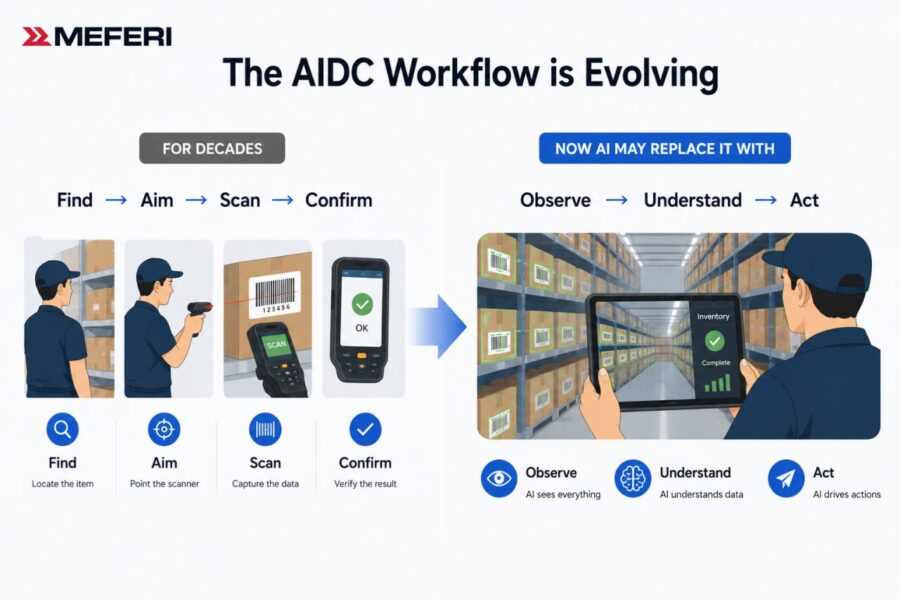

From Barcode Scanning to Visual Data Capture
For decades, the AIDC (Automatic Identification and Data Capture) industry has been built around a simple workflow:
Find → Aim → Scan → Confirm
Now, AI in AIDC may replace it with a different logic:
Observe → Understand → Act
Several leading AIDC manufacturers have already begun integrating AI-powered data capture into mobile computers and scanning solutions. Recent advances in computer vision now allow a single image to detect multiple barcodes, recognize labels, perform OCR, and extract structured information from warehouse environments.
This shift does not remove the need for enterprise devices. Instead, it changes what businesses expect from them. Modern MEFERI mobile computers are designed not only for barcode scanning, but also for enterprise mobility, software integration, and future-ready data capture workflows.
AI Vision in AIDC Still Faces Practical Limitations
The Hardware Problem Nobody Talks About

1. Camera Quality Matters for Computer Vision in Warehousing
AI can only analyze what the camera sees.
If the image lacks detail, the model cannot recover information that was never captured.
Many existing PDA devices were designed mainly for barcode scanning. They were not built for high-resolution computer vision in warehousing.
As AI in AIDC shifts toward image-based recognition, manufacturers face several hardware challenges:
- Higher resolution sensors
- Better optics
- Larger image files
- More processing power
- Higher hardware costs
As a result, the industry is beginning to move from “scanner-first” devices toward “vision-first” devices. Devices such as the MEFERI ME61 mobile computer show how enterprise mobile computers can combine scanning, camera capabilities, connectivity, Android enterprise support, and accessory ecosystems in one platform.
2. Distance Still Matters for AI Barcode Scanning
However, a common misconception is that AI solves everything.
It does not.
If a barcode occupies only a few pixels because the camera is too far away, recognition accuracy will still suffer.
Therefore, real deployments require a balance between:
- Camera resolution
- Field of view
- Recognition speed
- Device cost
The laws of physics still apply.
3. AI in AIDC Needs Computing Power
AI models require inference. Inference requires compute.
In practice, every enterprise must answer one important question:
Where should the AI run?
Possible options include:
| Deployment Model | Advantages | Challenges |
| Cloud AI | Powerful models, easy updates | Network dependency, data security |
| Edge AI | Fast response, offline capability | Hardware cost |
| Hybrid AI | Balanced approach | Complex architecture |
| Private Enterprise AI | Full data control | High maintenance cost |
Moreover, AI in AIDC is not only about algorithms. It is also about governance, security, and operational control. Organizations deploying AI systems should consider recognized frameworks such as the NIST AI Risk Management Framework.
Many organizations underestimate the effort required to build a proprietary vision model.
Training AI systems for barcode recognition, label detection, or warehouse object identification often requires:
- Large datasets
- Manual annotation
- Continuous retraining
- MLOps infrastructure
- Dedicated AI engineers
In fact, the model itself may only be 20% of the project. The operational ecosystem is the other 80%.
Could BYOD Replace Rugged PDA Devices in AI in AIDC?

At first glance, one interesting possibility is BYOD, or Bring Your Own Device.
After all, many modern smartphones already offer:
- 50MP cameras
- AI accelerators
- Fast processors
- High-quality displays
In some cases, consumer devices outperform older industrial hardware in image quality.
From a cost perspective, BYOD appears attractive:
- Lower hardware investment
- Faster deployment
- Familiar user experience
However, enterprises quickly encounter new challenges.
Security
Corporate data now resides on personal devices. Therefore, questions emerge around:
- Device management
- Data leakage
- Remote wipe policies
- Compliance requirements
For this reason, companies evaluating AI in AIDC must look beyond camera quality and processor performance. They also need to consider how devices are managed, secured, updated, and supported.
Reliability
Meanwhile, consumer devices are not designed for:
- 12-hour shifts
- Cold storage environments
- Dust exposure
- Frequent drops
This is where rugged enterprise devices remain highly relevant. As discussed in MEFERI’s article on Consumer vs Rugged Enterprise Devices, industrial operations require more than familiar hardware. They require durability, lifecycle stability, centralized control, and predictable performance.
Battery Continuity
In addition, a warehouse cannot stop operating because a personal phone battery dies.
Mission-critical operations require predictable uptime. This remains one of the biggest reasons rugged PDA devices and enterprise mobile computers continue to exist.
Consumer Smartphone VS Enterprise Mobile Computer
| Use Case | Consumer Smartphone | Enterprise Mobile Computer |
| AI assistant / knowledge search | Strong UX, powerful AI chips, familiar experience | Available, but not the core design focus |
| Barcode / OCR / product recognition | Possible, but less stable at scale | Core strength: scanner engine, SDK, triggers, tuning |
| Voice assistant | Good performance for individual use | Better for shared and controlled enterprise environments |
| Photo capture / proof of work | High-quality camera, easy to use | Stronger when linked to workflows such as WMS, POS, and task systems |
| Device fleet management | Possible, but fragmented because of BYOD issues | Centralized enterprise-grade lifecycle management |
| Harsh environments | Weak unless ruggedized | Built specifically for industrial conditions |
The Future of AI in AIDC: From Scanners to Visual Workers

The most important takeaway is this:
AI is not simply making barcode scanning faster. Instead, it is transforming the role of data capture itself.
The future AIDC workflow may look like:
Observe → Understand → Decide → Execute
Rather than scanning one barcode, systems will understand entire scenes. Instead of counting products manually, AI-driven AIDC workflows will monitor inventory continuously. Most importantly, AI will highlight anomalies automatically before workers need to search for problems manually.
We are already seeing early versions of this through:
- Multi-barcode recognition
- Shelf intelligence
- Product recognition
- OCR automation
- Computer vision inventory audits
- AI-assisted proof-of-delivery workflows
For businesses planning this transition, the right device strategy matters. Enterprise teams can explore MEFERI’s broader AIDC solutions and product ecosystem to understand how rugged mobile computers, scanners, software tools, and accessories can support scalable digital transformation.
Final Thoughts
In short, modern AI-driven data capture is clearly reshaping the AIDC industry, and this transformation is becoming unavoidable.
Nevertheless, enterprise-grade mobile computers, or PDA devices, still maintain irreplaceable advantages in today’s operational environments.
Beyond hardware capabilities, they provide robust manageability. This enables centralized deployment, device control, and policy enforcement at scale.
Moreover, they support a mature ecosystem of enterprise accessories, such as scanning docks, vehicle mounts, and extended battery systems. These accessories are critical for high-frequency frontline operations.
Finally, PDAs are built around a full enterprise lifecycle strategy. This includes long-term support, security updates, and predictable upgrade paths that help ensure operational stability over years of use.
From an ESG perspective, durability, repairability, and extended lifecycle can also help reduce electronic waste. This aligns better with corporate sustainability goals.
In short, while AI in AIDC is accelerating a shift toward more intelligent, vision-based workflows, today’s PDA devices remain foundational infrastructure for mission-critical operations. Reliability, control, and continuity are still non-negotiable.
To learn more about enterprise-grade mobile computers and AIDC solutions, contact MEFERI.





Leave a Reply